
How a logistics service provider spots new opportunities before the tender appears

5 signals types of public events that
indicate a new opportunity
Weekly an updated list,
rather than isolated messages
Before the tender the moment an opportunity
comes into view
← All client stories

The challenge

A logistics service provider grows through new cargo flows. These are rarely announced clearly, but the early signals are traceable online.

A new distribution center, a factory expansion, or a shipper re-tendering its transport: each is an event made public months in advance, hidden within permits, annual reports, press releases or zoning plans.

Although this information is public, it is scattered across hundreds of sources, totaling over 200,000 unstructured pages of text and data. It is impossible for people to track manually, and certainly not every week.

In practice, Sales only learned about an opportunity once the formal tender was published, well after the ideal window to proactively influence the scope.

Visible too late

The opportunity only comes into focus when the specifications are finalized. Strategic input on the setup is no longer possible.

Scattered across sources

Permits, zoning plans, annual reports and news are fragmented, each written in its own context and jargon.

Unsustainable manual labour

Manual searching takes hours every week and stays restricted to familiar clients and regions.

The solution

We built a dedicated AI pipeline: public sources are collected, read and classified by the model into actionable, relevant signals for Sales.

  • Sources are retrieved automatically, regardless of the source type
  • Every signal is normalized into the same fields: who, what, where, which year and what scale
  • The model evaluates whether a signal fits the provider's operating region and transport modes
  • Ambiguous cases go to a commercial manager rather than being automatically accepted or discarded
  • Every signal remains traceable back to the sentence in the original source

The AI pipeline: from 453 sources to 875 qualified leads

  1. 1453public sources retrieved across market data
  2. 2200,000+pages analyzed and processed
  3. 332,000potential opportunities identified
  4. 4,324recognized as a relevant fit
  5. 5875concrete, actionable leads
Phases of our framework covered
  1. 01AI strategy
  2. 02Process and opportunity analysis
  3. 03Use case portfolio
  4. 04AI Lab
  5. 05AI production and process redesign
  6. 06AI change management
View the full framework →

The result

1 list

One updated overview of matched opportunities every week, in place of random, ad-hoc alerts.

Previously
  • An opportunity only became visible when the tender was formally published
  • Search efforts were manual and confined to existing clients and known regions
  • The first opportunity found got the attention, regardless of whether it was the best fit
  • There was no overview of market activity outside the existing client base
Now
  • An opportunity enters the radar as soon as it becomes public, well ahead of the tender
  • Sources are read on a fixed cadence, expanding beyond familiar boundaries
  • Every signal has the same fields, enabling direct side-by-side comparison
  • The market across the entire service territory is visible in one overview

The application does not determine who to call. It ensures that outreach is driven by what is happening in the market rather than by what happened to come along.

Want to know more about this?

Frequently asked questions about AI for market intelligence

Which sources do you use?
Publicly available sources: environmental permits, zoning and development plans, tender notices, annual reports and news publications. Which sources count is determined together with Sales, tailored to the operating region and the transport modes.
Are you permitted to use this data freely?
Yes. The pipeline processes information that organisations publish voluntarily or are legally required to disclose. No personal data is processed, and no content is retrieved from behind a paywall or a login.
What qualifies a signal as a lead?
The criteria are defined by the sales organisation itself: cargo type, region, scale and timing. The model evaluates signals against those criteria and assigns a score. In case of uncertainty, a commercial manager makes the final call, not the model.
Does this approach work outside logistics?
Yes. The route from source to signal stays the same; only the sources and the criteria change. For a contractor those are budgets and investment plans, for an installer maintenance contracts and permits.
And your organisation?

Want to find out where your organisation stands today?

Every organisation works with AI, but everyone does it differently.

AI Maturity Assessment

Determine where your organisation stands in thirty questions

This case shows which phases of the Disruptiv framework another organisation went through. The assessment does the same for yours: you will not only see your score, but also which phase currently limits your progress and what needs to be done first.
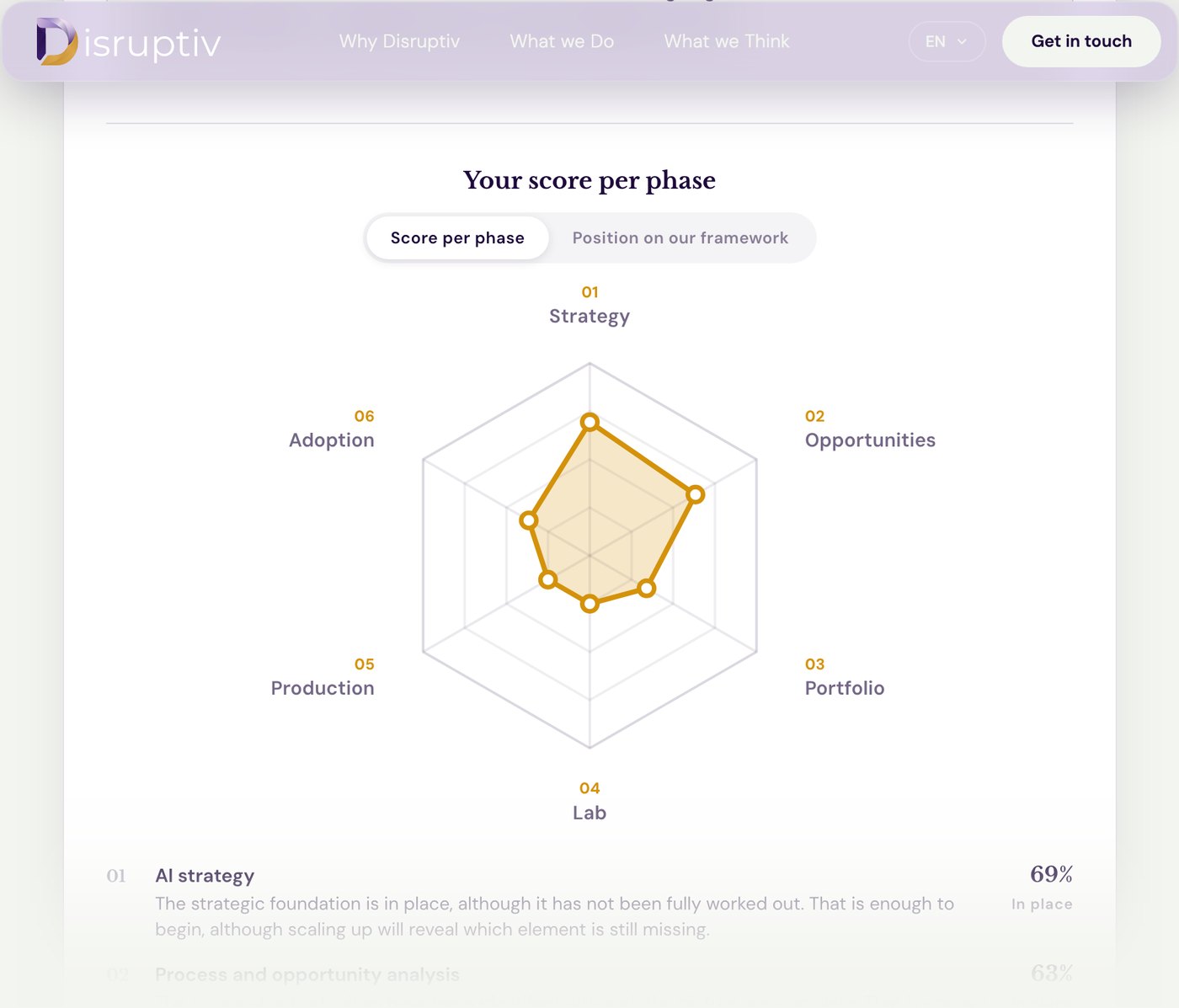
  • A score for each phase, along with a clear explanation of its meaning
  • Your exact position on our framework and the phase limiting your progress
  • The immediate next steps that will deliver the highest impact
Start the assessment
Screenshot of the result with the radar chart and the score per phase
Our Purpose

Reshaping Organisations
through Disruption,
together

Get in touch