
How a contractor saves €5.2 million on complex soil logistics

27% lower costs
for soil logistics
€5.2M saved over
five project years
5 years planned ahead,
in a single model
seconds to calculate
a change
← All client stories

The challenge

Dike reinforcement shown as a digital twin

For a river and dike project, the locations where soil was excavated, stored, and hauled off had to be determined five years in advance.

Soil balances and soil logistics represent one of the largest cost items that contractors can directly influence in these types of projects. At the same time, it is a complex topic. How do you calculate every scenario for a multi-year project? Modifying the execution method even slightly results in different soil logistics and earthwork balances. Due to the number of variables, there are over 100,000 possible schedules in total, making it impossible to recalculate them all manually.

Reusing soil within the project boundary is not only sustainable, but also often more cost-effective than removing soil or importing new material. On the other hand, soil cannot be stockpiled indefinitely.

As a result, work preparation engineers tried to calculate as many scenarios as possible manually using Microsoft Excel. This consumed a lot of time. The resulting model provided a reasonable estimate, but ultimately remained a best guess.

100.000+ possible schedules for a single project, too many to calculate manually.

The solution

We created a digital twin of the actual situation. Part of this is a model that finds the lowest-cost combination of excavation, storage, reuse, and disposal within the real-world context of the project.

  1. All project variables are included in a single model: schedule, soil types, capacity, transport distances, and transport costs.
  2. The model optimizes for total costs across the entire project lifecycle, finding the solution by minimizing this cost function.
  3. Work preparation teams can adjust the schedule themselves. A modified assumption is recalculated into total costs within seconds.

How the actual situation is translated into a digital twin

Mapping the situation

Together with the work preparation team, the key factors determining soil logistics are identified.

Translation to digital twin

These factors are incorporated into a digital twin. A change in the real-world situation is thus reduced to changing a single parameter.

Cost minimization

The model minimizes the cost function while taking into account the boundary conditions from the digital twin.

Phases of our framework covered
  1. 01AI strategy
  2. 02Process and opportunity analysis
  3. 03Use case portfolio
  4. 04AI Lab
  5. 05AI production and process redesign
  6. 06AI change management
View the full framework →
Motorway interchange with light trails, as an image of large-scale infrastructure work

The result

−27%

Lower soil logistics costs. Over five years, €5.2 million was saved compared to the multi-year plan prepared by the project team itself.

Manual planning €19.3M
Planning from the model €14.1M
Difference €5.2M lower
Before
  • The multi-year schedule was created manually in Excel.
  • Calculating a single scenario took a significant amount of time.
  • Out of more than 100,000 possible schedules, only a small portion was evaluated.
  • The chosen schedule was a good estimate, but remained a best guess.
Now
  • The schedule is calculated by a model based on a digital twin of the project.
  • A modified assumption is recalculated within seconds.
  • All valid schedules are tested and compared against one another.
  • The chosen schedule is guaranteed to be the plan with the lowest total cost.
Want to know more about this?

Frequently asked questions about AI-driven planning of soil logistics

What is a project digital twin?
A digital twin is a digital representation of the actual situation. Schedule, soil types, capacity, transport distances, and transport costs are recorded within it as parameters.
How does the model determine the lowest-cost schedule?
The model minimizes total costs across the entire project duration while taking into account all project constraints and boundary conditions.
Why can't this be done manually?
Due to the number of variables, there are more than 100,000 possible schedules. It is impossible to calculate all of them manually.
What happens if the situation changes during the project?
The change is adjusted as a parameter in the digital twin. The model then recalculates the entire multi-year schedule.
Does the model replace the work preparation engineer?
No. Work preparation determines which assumptions are placed in the model and assesses whether a schedule is executable. The model takes over the calculation work.
And your organisation?

Want to find out where your organisation stands today?

Every organisation works with AI, but everyone does it differently.

AI Maturity Assessment

Determine where your organisation stands in thirty questions

This case shows which phases of the Disruptiv framework another organisation went through. The assessment does the same for yours: you will not only see your score, but also which phase currently limits your progress and what needs to be done first.
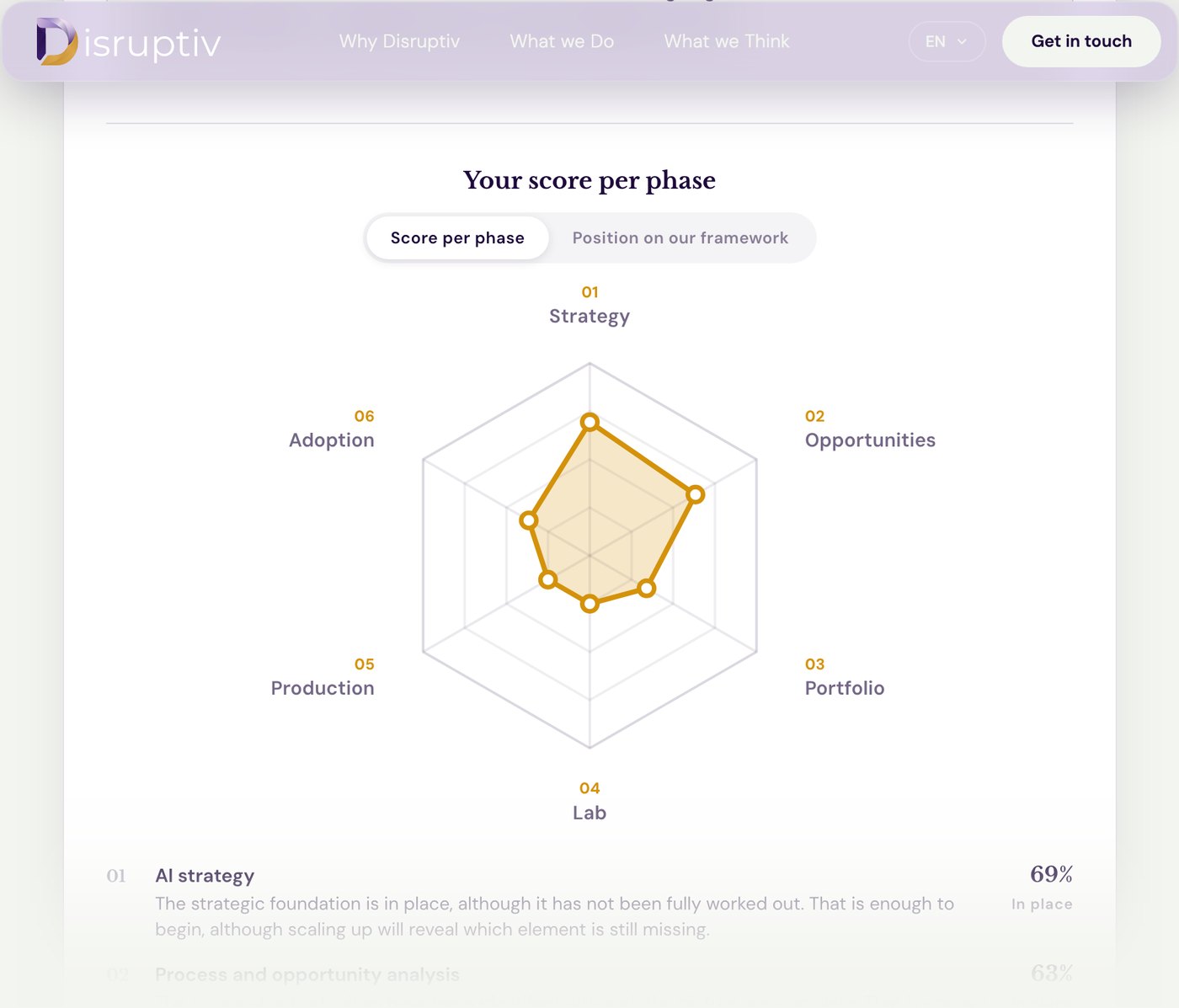
  • A score for each phase, along with a clear explanation of its meaning
  • Your exact position on our framework and the phase limiting your progress
  • The immediate next steps that will deliver the highest impact
Start the assessment
Screenshot of the result with the radar chart and the score per phase
Our Purpose

Reshaping Organisations
through Disruption,
together

Get in touch