Our purpose
Every technological breakthrough redefines the market. Steam, electricity and the internet did not reward those who implemented the technology fastest, but those who fundamentally redesigned their organisation around it. AI is the next breakthrough, and no industry is left untouched. The organisations of tomorrow redesign themselves around AI rather than bolting AI onto the existing organisation.
Disruptiv helps you redesign your organisation for the AI era, so you are able to grow significantly faster or operate far more efficiently.
Scroll on for the framework we use to make this happen for every clientFrom AI strategy to lasting AI adoption: our framework shows how we guide organisations and what results each phase delivers.
Step 01 · AI strategy
AI without direction leads to scattered initiatives. That is why we start by defining the ambition, goals, ground rules and responsibilities. We determine where AI should create value, where the boundaries lie and which principles take precedence. This creates a strategic framework for every choice that follows.
Step 02 · Process & opportunity analysis
Valuable AI applications emerge in practice. That is why we map out processes, activities, and information flows. This highlights where AI truly adds value and makes the greatest impact. The goal is not as much AI as possible, but the right applications in the right places.
Step 03 · Use-case portfolio
Every use case is summarised, scored, and prioritised based on impact versus feasibility. This delivers a strategic overview, allowing you to select initiatives based on ROI. Together, we then determine which use cases make it onto the roadmap and transition into active development.
Step 04 · AI Lab
We first develop and test the selected use cases on a small scale, validating feasibility and effectiveness prior to scaling up. This allows us to learn quickly and cost-effectively whether an idea truly works within your organisation before taking it into production.
Step 05 · AI production & process redesign
Instead of bolting proven use cases onto an old process, we rebuild the workflow around them and anchor the AI application within your IT and data landscape. Where systems, data flows, or ways of working fall short, we close the gaps. The result is not just a new AI application, but a renewed process supported by fully aligned systems.
Step 06 · AI change management
An organisation ultimately consists of people. An AI application, a renewed process, or a modern IT and data landscape is one thing; a workforce that can actually work with it is another. That is why we guide your people into new roles and ways of working, until collaborating with AI becomes second nature.
Examples of what our framework delivers in practice.
For a rivers-and-dikes project, the client had to determine five years ahead where soil would be excavated, stored and removed. Dozens of factors changed continuously, making this impossible to keep track of by hand.
We developed an AI model that takes over the calculations and computes the best possible multi-year plan:
A saving of €5.2 million in storage and transport costs over five years, compared with the multi-year plan that work preparation used to draw up by hand.
The client outsources a great deal of work, but quotes from subcontractors often arrive incomplete. Comparing them by hand took a lot of time and deviating terms were missed. Later in the project, that led to failure costs or disputes.
We developed an AI tool that brings the request and all the bids together, like a digital procurement colleague:
On each request, buyers gain up to twice as much time to negotiate and align more sharply. Because terms are pinned down better up front, execution brings fewer failure costs and fewer disputes over variation orders.
The client plans hundreds of refrigerated trips every day. That plan was fixed each morning, while traffic jams and rush orders kept changing the day. Replanning by hand took hours and led to empty miles and missed delivery windows.
We connected an AI planning module to the existing TMS, so planning runs continuously:
The AI absorbs the daily disruptions, so planners only step in for exceptions. Beyond the time saved, that delivers a 5% rise in on-time delivery on the bottom line.
The client processes dozens of weigh tickets every day. Some arrived on paper, while the weighbridges recorded their data digitally in separate systems. Employees then transferred that data by hand into other IT systems.
We developed an AI model that brings all the tickets together and files them instantly:
98% of processing now runs automatically. Only exceptions still reach an employee, and discrepancies are caught early rather than after the fact.
A logistics service provider grows with new freight flows. Those are announced in permits, annual reports and zoning plans, scattered across hundreds of sources. In practice, sales only heard about an opportunity once the tender was already out.
We built an AI pipeline that collects the sources, reads them and scores them for relevance:
One updated list every week with 875 qualified leads that match the operating area. Opportunities surface before the tender is published.
Every department needed different information, but it was locked away in the TMS, the WMS and separate HR systems. Employees clicked through multiple screens every day to monitor or report on a process, keeping the administrative burden high.
We rolled out an AI agent framework that connects the underlying systems:
Each department permanently frees up the capacity of one to two full-time employees. Teams are significantly relieved of manual administration and repetitive peripheral tasks.
The Contact Center of a municipality with over 35,000 residents receives around 700 digital customer inquiries each week. On average, an inquiry waited five business days for a response. The municipality is comitted to ensuring that no decision regarding a resident is ever made by an algorithm.
With a focus on responsible and ethical deployment, we built an AI assistant that drafts responses based on a knowledge base developed by the municipality itself:
Reponse time drops from five business days to less than two days, and resident satisfaction with digital contact increases. The municipality continues to focus on digital service thats is handled by an employee, but processed at a much faster pace.
Employees were already making extensive use of AI, ranging from free chatbots to self-purchased tools for retrieving information. There was little control over how AI was deployed, which led to irresponsible usage. A total ban would only drive the usage of Shadow AI, so the municipality had to implement a policy.
In the first phase, we mapped out current usage and translated it into a workable policy that focuses on responsible and ethical use:
Following the mapping of AI usage, a clear vision on AI and its safe and ethical deployment was developed. This leads to more responsible and transparent use of AI in municipal services.
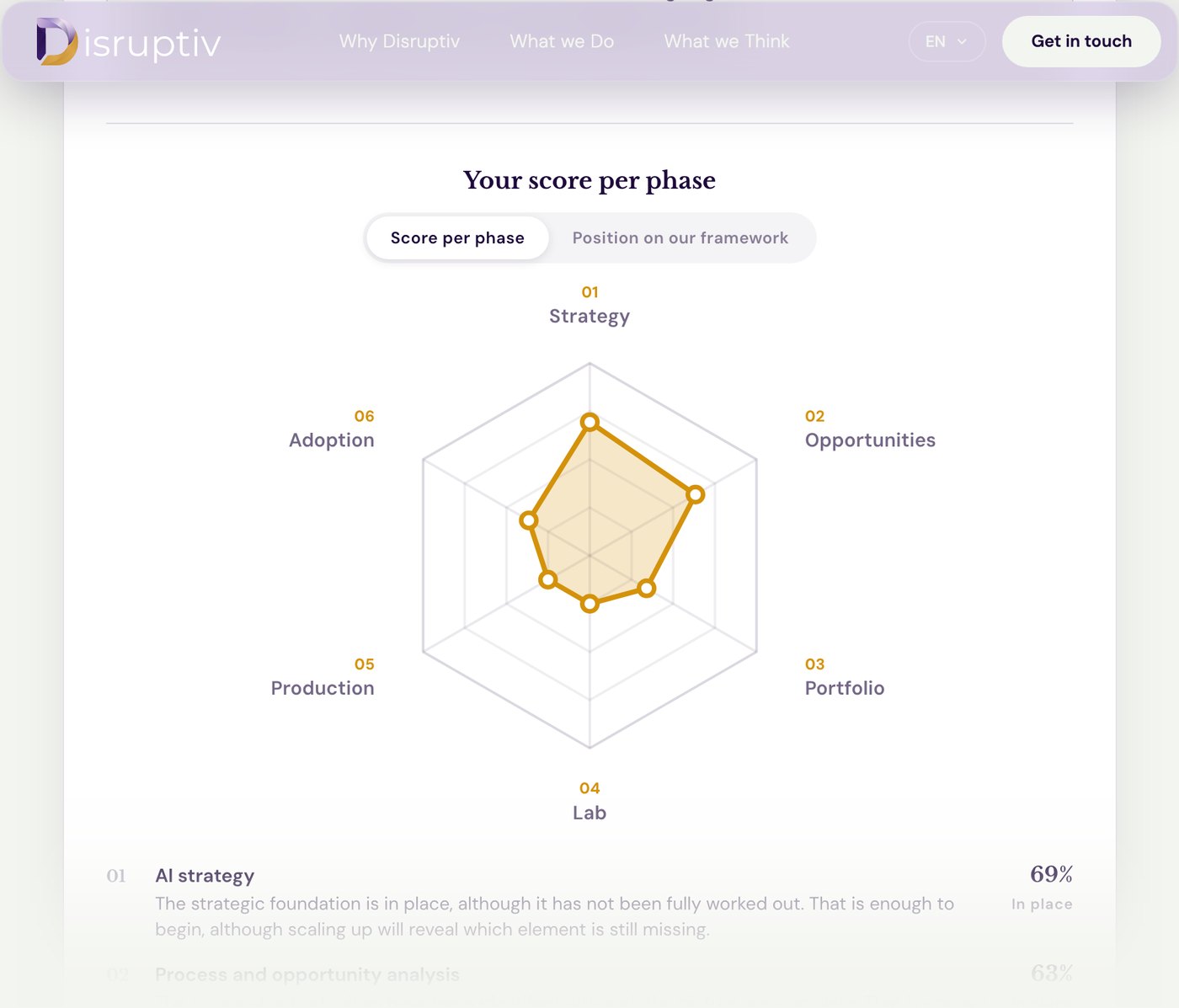
Find out where your organisation stands and determine the best way forward.
The assessment maps your organisation across the six phases of this framework. You will not only see your score, but also which phase currently limits your progress and what needs to be done first.

We would be glad to take the time to get to know you and hear what is on your mind. An open conversation where we explore together whether we're a good fit. Want to dig deeper into something you read on our site? We are happy to make time for that too.
Get in touch