How a municipality answers digital questions from residents 65% faster using AI

65% faster processing
of digital inquiries
100% of answers checked
by a human
Increase in resident
satisfaction
← All client stories

The challenge

A municipality wanted to improve and accelerate its service delivery using AI, without decisions about residents being made by an algorithm.

The customer contact centre received approximately 700 digital inquiries per week across a wide variety of topics, including parking permits, waste management and local taxes. To provide accurate answers, employees had to gather information from disparate and scattered sources. An average inquiry had a wait time of five business days for a response.

AI was considered capable of accelerating the municipality's service delivery, but the key question was: how can this be done without undermining residents' trust, and how do we do it ethically? The municipality therefore needed complete transparency regarding the deployment of AI and its impact on public services.

The assignment was therefore two-fold: demonstrably improve service delivery through AI, and do so in a responsible and ethical manner that the municipality can clearly explain to its residents.

The solution

We started by mapping out where most time was lost and identified where AI was and was not permitted to assist.

  • In collaboration with the municipality, the impact of AI on people and service delivery was determined, both internally and externally
  • An AI assistant that generates draft answers strictly based on a knowledge base the municipality manages itself, preventing hallucinations based on incorrect information
  • Every draft answer is reviewed, adjusted if necessary and sent by an employee; the AI assistant cannot send anything itself
  • Inquiries about a resident's rights or benefits, such as the Social Support Act or special assistance, are excluded and go straight to a specialist
  • Data processing within a secure European environment, so resident data is handled safely

What the AI assistant does

  • Reads the resident's inquiry and identifies the topic
  • Drafts a response based on the municipality's knowledge base
  • Cites the specific source for each part of the answer
  • Flags when an inquiry falls outside the permitted topics

What the employee does

  • Evaluates the draft for accuracy and tone
  • Supplements the response with information only a human can extract from the case file
  • Sends the response; the assistant cannot send messages
  • Takes full responsibility for every decision affecting a resident
Phases of our framework covered
  1. 01AI strategy
  2. 02Process and opportunity analysis
  3. 03Use case portfolio
  4. 04AI Lab
  5. 05AI production and process redesign
  6. 06AI change management
View the full framework →

The result

65%

Shorter processing time for digital inquiries: from an average of five business days to less than two days.

The resident

Receives an answer within two days, still written in a human tone and complete with a reference to the source behind the information.

The employee

No longer starts from scratch when searching for information, freeing up time for residents with complex or sensitive inquiries.

The municipal council

Can explain where AI is used in public services, with an application that is recorded in the official Algorithm Register.

Resident satisfaction with digital communication increased over time: they receive faster responses without feeling as though they are being handled by AI.

Want to know more about this?

Frequently asked questions about responsible AI in public services

May a municipality use AI when communicating with residents?
Yes, provided you define in advance what it can and cannot be used for, and can fully justify its deployment. Here AI only assists in drafting responses to informational inquiries. Decisions affecting residents remain entirely with employees, and the application is recorded in the Algorithm Register.
What happens to residents' personal data?
Data is processed within a secure European environment and is never used to train models. Where an answer does not require personal data, it is redacted beforehand. This protocol was developed in close collaboration with a privacy officer.
How do you prevent the AI from giving incorrect information?
The AI assistant retrieves answers strictly from a knowledge base the municipality manages itself and cites the source for every response. An employee reviews and sends each message. In addition, a monthly random sample is assessed for accuracy, tone and equal treatment.
Are customer contact centre employees being replaced?
No. The team size has remained unchanged. The time that is freed up goes to residents with complex or sensitive questions, who now reach an employee much faster.
And your organisation?

Want to find out where your organisation stands today?

Every organisation works with AI, but everyone does it differently.

AI Maturity Assessment

Determine where your organisation stands in thirty questions

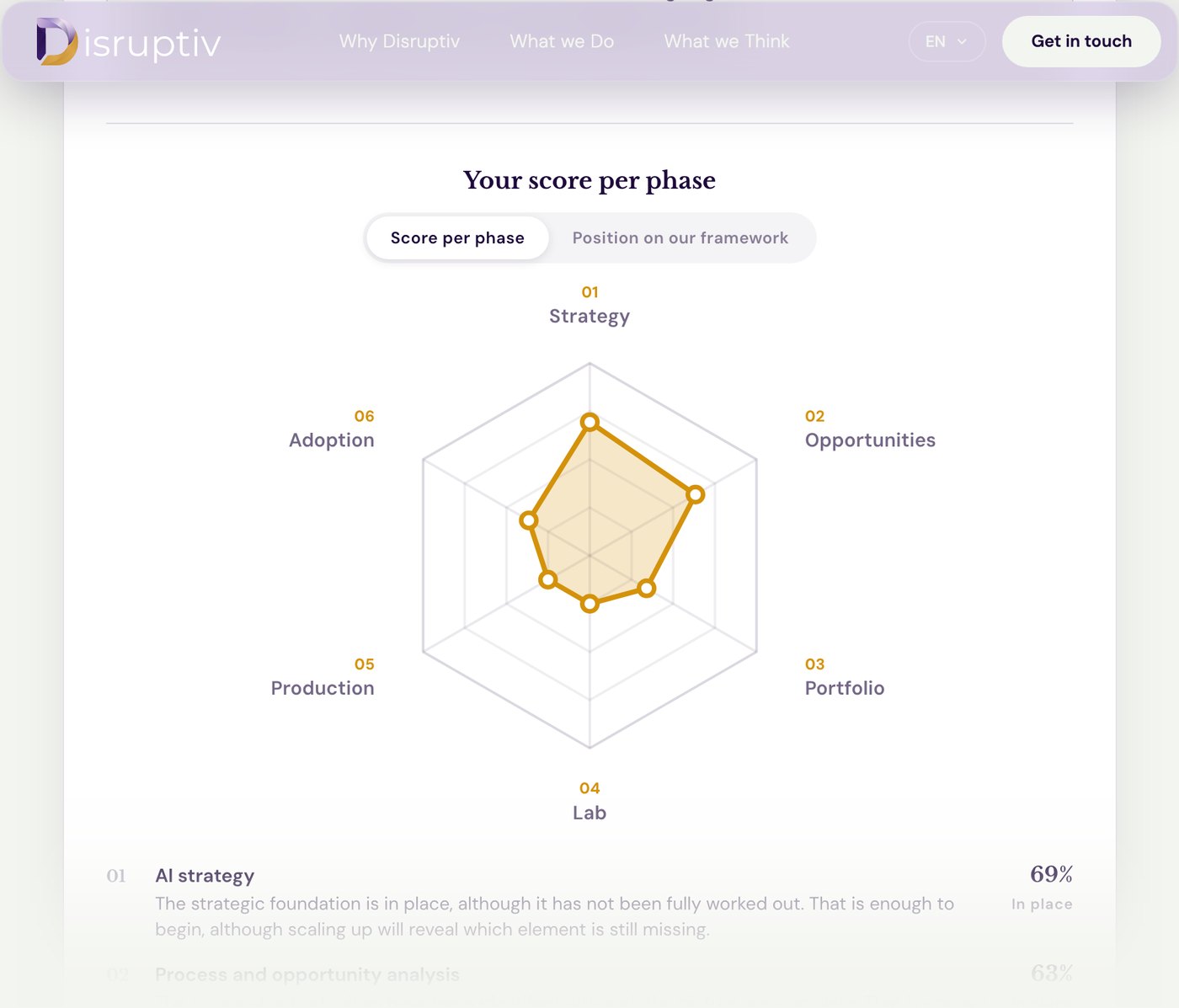
This case shows which phases of the Disruptiv framework another organisation went through. The assessment does the same for yours: you will not only see your score, but also which phase currently limits your progress and what needs to be done first.

  • A score for each phase, along with a clear explanation of its meaning
  • Your exact position on our framework and the phase limiting your progress
  • The immediate next steps that will deliver the highest impact
Start the assessment
Screenshot of the result with the radar chart and the score per phase
Our Purpose

Reshaping Organisations
through Disruption,
together

Get in touch