
How departmental AI assistants reduce search and administrative work by 1 to 2 FTE

1-2 FTE capacity freed up
per department
3 departments live:
finance, warehouse, safety
4 systems integrated
via a single agent framework
← All client stories

The challenge

Departments lost a significant amount of time searching for information dispersed across the TMS, the WMS, and separate HR and financial systems.

To answer a single question or prepare a report, employees spent time every day searching across multiple systems for the required data. That information then had to be linked together manually, even though each system had its own export formats and its own definitions.

This resulted in substantial lost time: looking up the same data, retyping it, placing it side by side, and verifying consistency. Recurring reports were often compiled manually month after month, leaving continuous uncertainty about the accuracy of the figures.

During peak periods, or when the colleagues who usually built these data links were absent, answering a question took longer or reports were skipped entirely, leaving the organization with the least visibility precisely at its busiest moments.

Logistics routes drawn as light lines across the road network
Answering a single question from management meant searching four systems:
TMS

Trips, status updates, and daily exceptions.

WMS

Inventory levels and the orders being fulfilled from them.

HR

Schedules, staffing levels, and availability.

ERP

Invoices, contracts, and financial processing.

The solution

Instead of a generic chatbot, we developed a dedicated AI assistant for each department, each configured with its own access rights.

  • An AI agent framework that connects the TMS, WMS, HR, and financial administration systems
  • One tailored assistant per department, for finance, warehouse, and safety, each with its own remit and its own sources
  • Answers synthesized from multiple systems, complete with a source citation for each component
  • Recurring analyses and reports prepared automatically by the assistant instead of by hand
  • Access rights aligned with the existing authorization model: employees gain no additional data privileges via the assistant

Examples of instant queries handled by the assistants:

Finance

Which trips remain unbilled, and why?

The assistant compares trip statuses against billing records and contract terms to detect discrepancies.

Searches across
TMSBillingContracts
Warehouse

Where are operational bottlenecks occurring today?

Inventory levels, incoming trips, and today's staffing schedule are consolidated into a single answer instead of three separate systems.

Searches across
WMSTMSWorkforce planning
Safety

Which incidents are recurring most frequently this quarter?

Incident reports are grouped by type, location, and timestamp, with the underlying records included for auditability.

Searches across
Incident reportsTMSHR

The assistants were added to a process that already ran on these systems:

Microsoft Dynamics 365 Microsoft Copilot Microsoft Azure
Phases of our framework covered
  1. 01AI strategy
  2. 02Process and opportunity analysis
  3. 03Use case portfolio
  4. 04AI Lab
  5. 05AI production and process redesign
  6. 06AI change management
View the full framework →

The result

1-2 FTE

Of capacity is structurally freed up per department, because staff no longer lose time to administration and repetitive searching.

Want to know more about this?
  • Queries that previously required checking multiple systems and screens now return a single answer with source attribution
  • Recurring analyses and reports run automatically, regardless of the operational workload
  • Employees retain time for exception management and evaluation rather than data collection
  • New employees are productive sooner: they no longer need to learn four separate platforms just to answer a question

Frequently asked questions about AI assistants on your own data

Why a dedicated assistant per department instead of one for the whole organization?
Because departments use different data sources, terminology, and permissions. An assistant with a clearly bounded scope gives more accurate answers and is easier to audit.
Can an employee see more via the assistant than through normal access?
No. The assistant enforces the existing authorization model of the source systems. Data someone cannot access remains completely restricted.
How do we verify the accuracy of the answers?
Every answer cites the source it came from, so an employee can check it. In addition, periodic sample audits are performed.
Will these assistants lead to job losses?
No. The organization primarily suffered from capacity shortages it could not fill through recruitment. The freed-up capacity is redirected to overdue work: analysis, quality control, and resolving exceptions.
And your organisation?

Want to find out where your organisation stands today?

Every organisation works with AI, but everyone does it differently.

AI Maturity Assessment

Determine where your organisation stands in thirty questions

This case shows which phases of the Disruptiv framework another organisation went through. The assessment does the same for yours: you will not only see your score, but also which phase currently limits your progress and what needs to be done first.
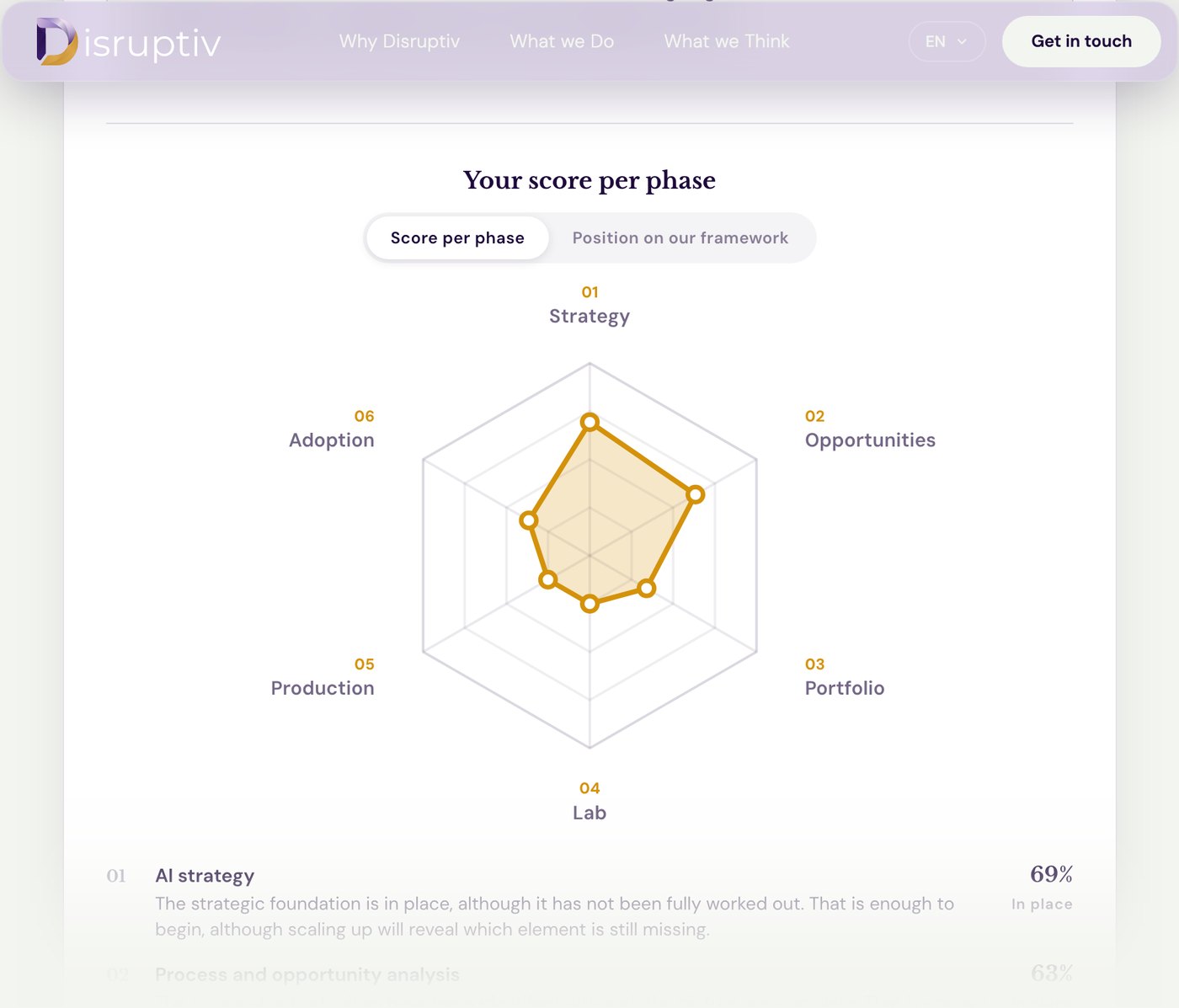
  • A score for each phase, along with a clear explanation of its meaning
  • Your exact position on our framework and the phase limiting your progress
  • The immediate next steps that will deliver the highest impact
Start the assessment
Screenshot of the result with the radar chart and the score per phase
Our Purpose

Reshaping Organisations
through Disruption,
together

Get in touch