Quotes come back in all shapes and sizes, which makes them hard for buyers to compare with one another.
A Dutch infrastructure group subcontracts a large share of its work. Every request for quotation comes with a bill of quantities. It states, for each specification item, which work has to be carried out and in what quantity. The supplier fills in its unit price against each item.
Not every supplier works that way. One returns the bill of quantities filled in. Another sends its own price sheet in which items are merged or calculated with its own quantities. A third gives a single rate per square metre that also covers the preparatory work. Terms on price validity, payment, certification and exclusions sit in a different place in every quote.
Buyers transferred the quotes into a spreadsheet by hand. Every price had to be converted back to the items and quantities from the request, allocating a lump sum here and converting a supplier's own quantity there. That work returned with every request. In practice, the comparison therefore often came down to the total price, while the underlying items and the terms received less attention.
Discrepancies were not always spotted that way. An item that had not been quoted, a missing certificate or a surcharge that only applies under certain conditions did not always stand out. Those points surfaced during execution instead, as additional work or as a discussion about scope. A quote that looked cheapest on paper did not always turn out to be the best buy.
The request
| Item no. | Description | Qty | Unit | Price |
|---|---|---|---|---|
| 154110 | Laying the bedding layer | 11,600 | m² | ______ |
| 154210 | Laying concrete paving stones | 11,600 | m² | ______ |
| 154320 | Laying kerb edging | 355 | m | ______ |
Three quotes
We developed an AI assistant that reads every quote, asks the relevant questions on its own initiative and standardises them, so a buyer can compare them at a glance.
As much time now goes into the conversation with the supplier instead of into comparing quotes.
The price and terms matrix
| Three suppliers | A | B | C |
|---|---|---|---|
| Price per specification item | |||
| Laying the bedding layer11,600 m² | € 1.25 | in the stone rate | € 2.25 |
| Laying concrete paving stones11,600 m² | € 10.25 | € 7.85 | € 8.50 |
| Laying kerb edging355 m | € 9.00 | € 8.50 | € 6.00 |
| Total across thirteen itemsexcluding VAT | € 204,743 | € 131,857 | € 172,543 |
| Difference from the lowest | + 55% | lowest | + 31% |
| Terms from the request | |||
| Payment term | |||
| Delivery of material to the site | |||
| Electric equipment | |||
| Certification | |||
The scope and the terms are clear up front. That leads to less discussion about additional work during execution and to lower failure costs.
Every organisation works with AI, but everyone does it differently.
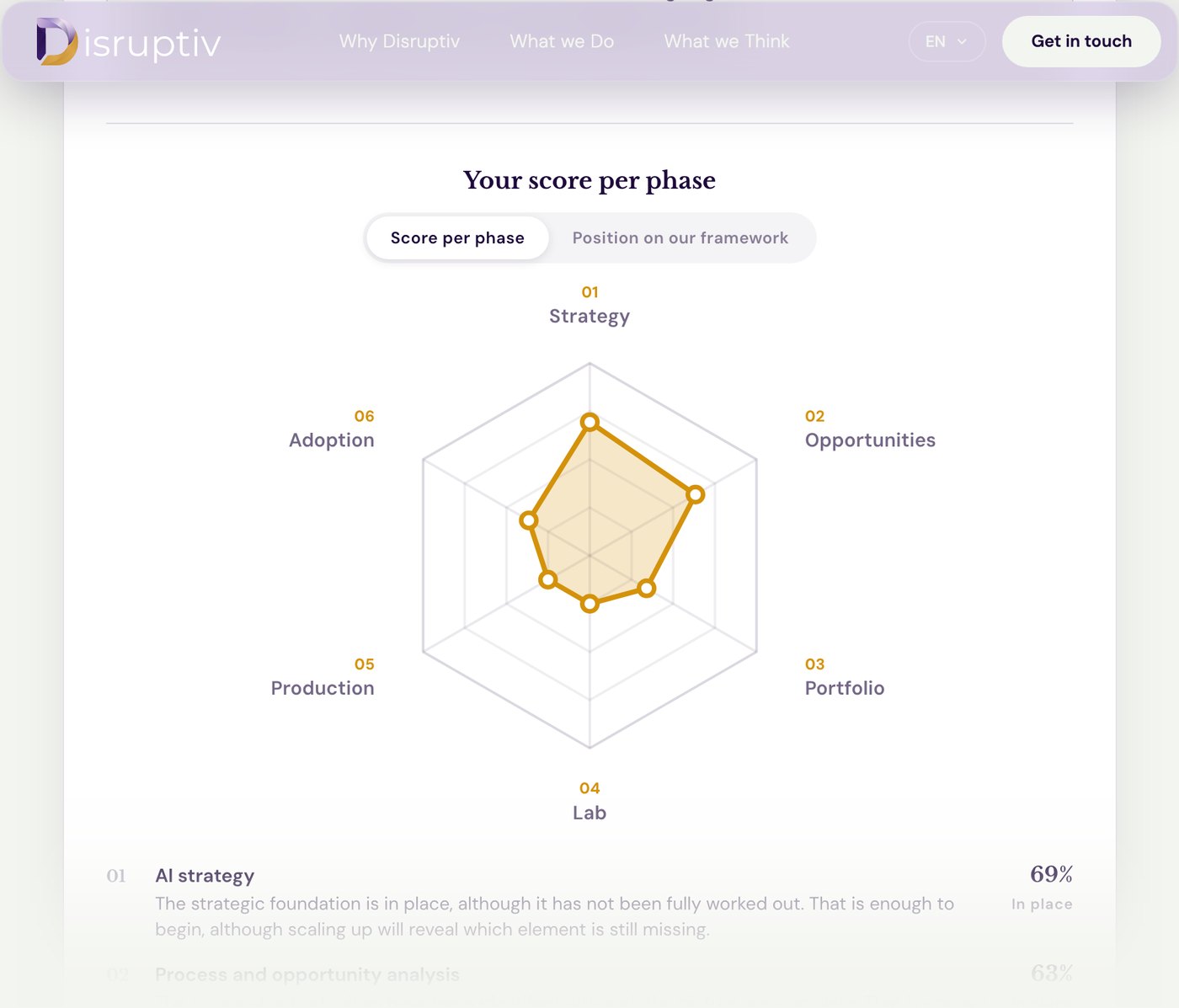
This case shows which phases of the Disruptiv framework another organisation went through. The assessment does the same for yours: you will not only see your score, but also which phase currently limits your progress and what needs to be done first.
Planning five years of soil logistics by hand was no longer manageable. An AI model now calculates every variant and picks the lowest-cost route.
Read case →Residents waited five working days for an answer. An AI assistant now drafts replies, but a staff member always checks and sends them.
Read case →The plan was fixed each morning, while traffic jams and rush orders kept changing the day. An AI module now re-plans on every disruption and planners only step in for exceptions.
Read case →